‘My favourite piece of music is the one we hear all the time if we are quiet.’
John Cage

‘My favourite piece of music is the one we hear all the time if we are quiet.’
John Cage
A student arrived for a lesson this morning with the last movement of Hans Ulrich Staeps’s Virtuose Suite (1961) on her agenda. Recorder players will know this composer’s name – at least, I hope they will – but very few other musicians will have heard of him. On the teaching faculty at the Vienna Conservatory for much of his life, Staeps wrote a lot of good music for the recorder, usually in a neo-baroque style with a liberal dash of neo-impressionism – sounding like a good Austrian who holidayed just enough in Paris. He wrote solos, duets, trios and works for larger ensembles of recorders, as well as a fair bit of chamber music incorporating keyboard, guitar and other instruments. I first encountered his music during my earliest experiences of consort playing at age ten or eleven, and more recently included a couple of his works on a recording of mid-twentieth-century repertoire, Fruit of a Different Vine. His Reihe kleiner Duette (A Series of Little Duets) is a particular delight, a bit like Kandinsky for the ears.
Many of Staeps’s pieces are dedicated to his students, and in the case of the Virtuose Suite each of its four solo movements are dedicated to a different person. This morning my student was valiantly tackling the final and most challenging movement, Presto Possible, a blistering two-page exercise in double tonguing. It does contain a few less frenetic moments but the main point is to dazzle and amaze without self-combusting, following in the ‘grand finale’ tradition. This particular movement was dedicated to Linde Höffer von Winterfeld (1919-1993), she of the elegant, nobility-tinged name who went on to write method books, studies and articles on recorder literature, and to edit a lot of music. She was another devoted pedagogue, though perhaps she went just a tad too far when she provided us all with 199 Thumb Exercises. Call me lazy or undisciplined, but wouldn’t forty have been enough?
When I was twelve I met Hans Ulrich Staeps at a music education conference in Toronto. Upon our introduction he said something nice to me and patted my head, a gesture I could have done without because it made me feel half my age, but I really loved his little Triludi trios so I more or less forgave him. He was also the first Fancy Recorder Person (FRP) I ever met. I was at the conference to play in some sort of student performance for my recorder teacher Isabel Smaller, a devoted educator who spent her working life driving around the city to teach at one or two different schools every day of the week. I have vivid memories of random plastic recorders, instrument cases and sheet music strewn across the back seat of her white Volkswagen beetle. More on Isabel later.
That last movement of the Virtuose Suite was on my program for a Canada Council audition at one of the critical moments of my nascent career, and I think it was that movement that convinced the jury on my behalf; but that’s another story too.
The Virtuose Suite is available from your favourite music publisher.
Here’s a movement from Staep’s Sonata in E-flat for alto recorder and piano, played by yours truly with Alayne Hall, piano.
I was playing a gig last year in St. Alban’s, the building which I’m told would have become Toronto’s cathedral had the money in the neighbourhood not run out…During a rehearsal break I walked a circuit of the sanctuary to check out the new stained glass window images of angel musicians. Dazzling and funky, they included a recorder player. I found out later that the glass work was done by Jane and Kathy Irwin, two women I first knew in high school. A striking image, to which my photography doesn’t do justice, but here it is, plus a link to the artists’ site.
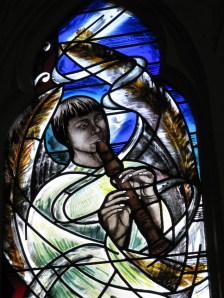
Stained Glass by Jane and Kathy Irwin
Hello world, and welcome.
I’m here to share my experiences as a musician, and more specifically as player of the recorder and early flutes, which I’ve been doing for my living for many years now.
I’d like to share anecdotes from my career; appreciations of mentors, colleagues and students without whom my life would be so much poorer; musings on the value and purpose of music; occasional bits of advice; and thoughts about repertoire, instruments, etc. I’ll also reflect on the experiences shared by players of recorder and historical flutes, and how we and our instruments are seen by the rest of the musical world (well, some of it). I’d like to share music, imagery, links to the websites of interesting and inspiring players, and many more things…And last but definitely not least, I’d like to connect with others interested in these subjects, so I hope you’ll be in touch.
This blog is named for Calliope, one of the nine Muses of ancient Greece, and for her sister Euterpe. Calliope was the Muse of epic poetry and was usually depicted with a writing tablet in her hand, while images of Euterpe, the Muse of lyric poetry, show her carrying a flute. Interestingly, none of the nine sisters are in charge of music – that was in the job description of their father Apollo – so if musicians in general (and flute players in particular) are looking for a Muse to whom we might relate, the likely choice would be Euterpe.
But I chose Calliope’s name here because it’s a bit more familiar, perhaps a bit easier to pronounce, and coincidentally it’s also the name of a musical instrument, so it ties quite well into this blog’s theme. In addition, the calliope isn’t universally regarded as a ‘real’ musical instrument – a characteristic shared by the recorder. And as you might imagine I’ve got a few things to say about that.
Stay tuned.
P.S.
If you’re wondering about how to pronounce the names, it’s ‘Kall-EYE-o-pee’ and ‘Yoo-TER-pee.’
For some basic information about the calliope:
 Calliope's Sister